
You send a payment to your credit card on Friday. By Wednesday, a tank of gas and a takeout night have eaten half of it back. If paying down debt feels like climbing a down escalator, this guide is for you: here’s how to stop using credit cards, starting with a seven-day pause and, if the card has been covering groceries and bills, a 14-day plan to get off it without bouncing a payment.
Here on the climb, this week’s move: no new debt. Not forever. Just long enough to see what changes, and to find out which kind of card problem you actually have.
Updated November 25, 2026 · General education, not legal or financial advice
First: is it a habit or a gap?
People reach for a card for two very different reasons, and the fix depends on which one is yours.
- A habit problem: there’s money in checking, but the card is faster, saved in every app, and easy to forget about. Takeout, online carts and “it was only $12” charges. The seven-day challenge below is built for this.
- A gap problem: the card is paying for groceries, gas and bills because the paycheck runs out before the month does. Hiding the card doesn’t fix that; it just moves the shortfall somewhere else. The 14-day plan further down is built for this.
Many of us have a bit of both. Read the seven-day steps either way, then run the 14-day check before you stop using the card for anything essential.
Why new charges cost more while you carry a balance
Here’s the part many of us never got told. A credit card’s interest rate is stated as a yearly rate, called the APR (annual percentage rate). The Consumer Financial Protection Bureau explains that on most cards you can avoid interest on purchases by paying the full balance each month by the due date.
That interest-free window is called a grace period, and it has a catch. The CFPB says that if you lose your credit card grace period by not paying in full, you’re charged interest on the unpaid balance, and new purchases in the next cycle can start building interest from the day you make them. Cash advances usually start charging interest right away, too.
So if you’re carrying a balance, a new swipe usually isn’t “free until the bill comes.” It may start costing you that same day. That’s why a short pause can matter more than it looks. And if your rate is high, it’s worth a ten-minute call to ask for a lower interest rate, too.
If you haven’t looked at your real numbers yet, here’s how to read a credit card statement and find where the APR and balance live.
How to stop using credit cards for 7 days
You don’t need willpower of steel. You need fewer moments where the card is the easiest option. One small step a day:
- Monday: Pick your backup. Decide how you’ll pay this week: debit card, cash, or both. Check what’s actually in checking.
- Tuesday: Move the cards. Take them out of your wallet. Put them somewhere boring, like a folder in a drawer. Don’t cancel anything this week; the goal is a pause, not a big decision.
- Wednesday: Delete saved cards. Remove card numbers from shopping apps, food delivery apps and your browser. A few extra steps at checkout give you a moment to think.
- Thursday: List the automatic charges. Write down subscriptions and bills that hit your cards on their own. Our subscription sweep shows where to look. You don’t have to switch them all yet; just know what’s coming.
- Friday: Plan the weekend. Weekends are where swipes sneak in. Choose one free or low-cost plan and set a cash or debit limit.
- Saturday: Shop with a list. Groceries and errands, list first, backup payment only.
- Sunday: Count it. Write down every time you reached for a card and didn’t. That’s your win for the week.
What counts as a real emergency?
Life doesn’t pause because you’re running a challenge. Before using a card this week, ask three questions:
- Is it necessary? Health, safety, keeping your home, or keeping your way to work.
- Is it urgent? It truly can’t wait until your next paycheck.
- Is it unexpected? It wasn’t on the calendar. Birthdays and annual fees don’t count; they’re just bills nobody reminded you about.
If all three are yes and there’s no other way to pay, using the card isn’t failing. Write it down, note why, and keep going. A cracked windshield is not the same as a 2 a.m. “add to cart.”
Even a small cushion makes these moments rarer. A starter emergency fund is the long-term partner to this week’s pause.
Here’s an example with made-up, round numbers
Jordan owes $2,000 on one card. Last month Jordan paid $200 toward it but charged $150 in small stuff: lunches, an app subscription, a few gas fill-ups. The balance barely moved.
This week Jordan moves the card to a drawer, deletes it from two apps, and pays for gas and groceries with debit. A forgotten $15 streaming charge still hits the card. That’s fine; it goes on Thursday’s list to switch next month.
By Sunday, Jordan has skipped the card six times. On Jordan’s debt list, the next payment can finally push the balance down instead of just catching up.
How to stop using credit cards to pay for normal living expenses
If the card has been covering food, gas and bills, the first step isn’t willpower. It’s finding the exact size of the gap, day by day, before you switch anything. A monthly total can look fine while one week still crashes, so line up the next 14 days on paper:
- Write down what’s in checking right now, and subtract any debit purchases that are still pending.
- Add each paycheck on the day it actually lands, not the day it’s “supposed to.”
- Subtract essentials (food, gas, medicine) for each week, plus every bill and card minimum due in the 14 days, including autopays.
- Find the lowest number. That’s your real gap or your real cushion.
A 14-day example with made-up, round numbers
Here’s an example with made-up, round numbers. You have $420 in checking, one $40 debit purchase still pending, and a $1,000 paycheck coming on Day 8. Food, gas and medicine run about $25 a day. You’ve moved the $60 phone bill off the card, card minimums of $90 are due on Day 5, electric autopays $110 on Day 12, and $900 rent is due on Day 15.
| Day | What happens | In / out | Cash after |
|---|---|---|---|
| Day 1 | Cash in checking today | $420 | |
| Day 1 | Debit purchase still pending (not posted yet) | −$40 | $380 |
| Days 1–7 | Food, gas and medicine, about $25 a day | −$175 | $205 |
| Day 3 | Phone bill, moved off the card to checking | −$60 | $145 |
| Day 5 | Card minimum payments | −$90 | $55 |
| Day 8 | Paycheck | +$1,000 | $1,055 |
| Days 8–14 | Food, gas and medicine | −$175 | $880 |
| Day 12 | Electric bill (autopay from checking) | −$110 | $770 |
| Day 15 | Rent | −$900 | −$130 |
Two things jump out. Day 5 leaves only $55 until payday, which is thin but positive. And Day 15 comes up $130 short. That $130 is the honest size of this gap. It’s probably about how much was landing on the card each month, and it’s why “just stop swiping” never worked.
If the gap is small, a few changes may close it: shift a due date (line up your bills with your paydays shows how to ask), trim one flexible cost, or shop from a list for two weeks. Run the 14 days again after each change. Stop using the card for essentials only when the lowest number stays at zero or above.
If the gap stays negative
If the lowest number is still below zero after an honest trim, that’s a budget telling you something, not a character flaw. Pay for the essentials first, and use our guide to which bills to pay first for the order. Call the card company before a payment is late and ask about a hardship plan. You can also talk with a nonprofit credit counselor: the CFPB says credit counselors can help you build a budget and may set up a debt management plan that typically lowers monthly payments, and it suggests getting any fees in writing first.
Want to see what minimum payments alone would cost you over time? Plug your balance into our free credit card minimum payment calculator. It takes about a minute.
Moving recurring charges off your card safely
Locking or hiding a card stops most new swipes, but Experian notes recurring payments can still go through a lock (see the FAQ below). So each automatic charge needs its own switch, at the company. Don’t move everything to debit on the same day. Switch one at a time, on a date when the cash will already be there. Here’s an example list, using made-up numbers:
| Charge | Next date | On card now | Safer move | Watch out for |
|---|---|---|---|---|
| Streaming service | Day 9 | $15 | Cancel or pause it, or move it after payday | A locked card may still let it through |
| Phone bill | Day 3 | $60 | Switch to checking on a date right after payday | Autopay hitting before the paycheck clears |
| Car insurance | Day 20 | $120 | Change the payment method on the insurer’s site, then confirm the next charge date | Missing a payment while the switch processes |
| Gym membership | Day 25 | $30 | Cancel the contract, not just the payment, if you’re done with it | Canceling payment doesn’t cancel what you owe |
Our subscription sweep shows where these charges hide. If you move a bill to checking and later want to stop it, the CFPB explains you have the right to stop automatic payments from your bank account: tell the company and your bank, follow up in writing, and keep track of the dates. Canceling the payment doesn’t cancel what you owe, so pay another way or cancel the contract too.
Debit and cash have risks too
Switching to debit is safer for your balance, but it isn’t risk-free. The CFPB explains that an overdraft happens when your account doesn’t have enough money but the bank pays the transaction anyway, and many banks charge a fee on top of repaying the amount. It also warns that deposits may not be available right away. That’s why the 14-day check subtracts pending purchases and uses the day pay actually lands.
If it’s mostly impulse buys
If your 14 days come out positive and the card is mostly carrying extras, the seven-day steps do most of the work. Two more that help: unsubscribe from store emails and app alerts for the week, and give any non-essential purchase a 24-hour wait. If you still want it tomorrow, pay with debit from money you already set aside.
Your no-new-debt week checklist (copy this)
- My backup payment: ______
- Where my cards are this week: ______
- Apps where I deleted saved cards: ______
- Automatic charges still on my cards: ______
- My emergency test: necessary, urgent, unexpected
- Times I reached for a card and didn’t: ______
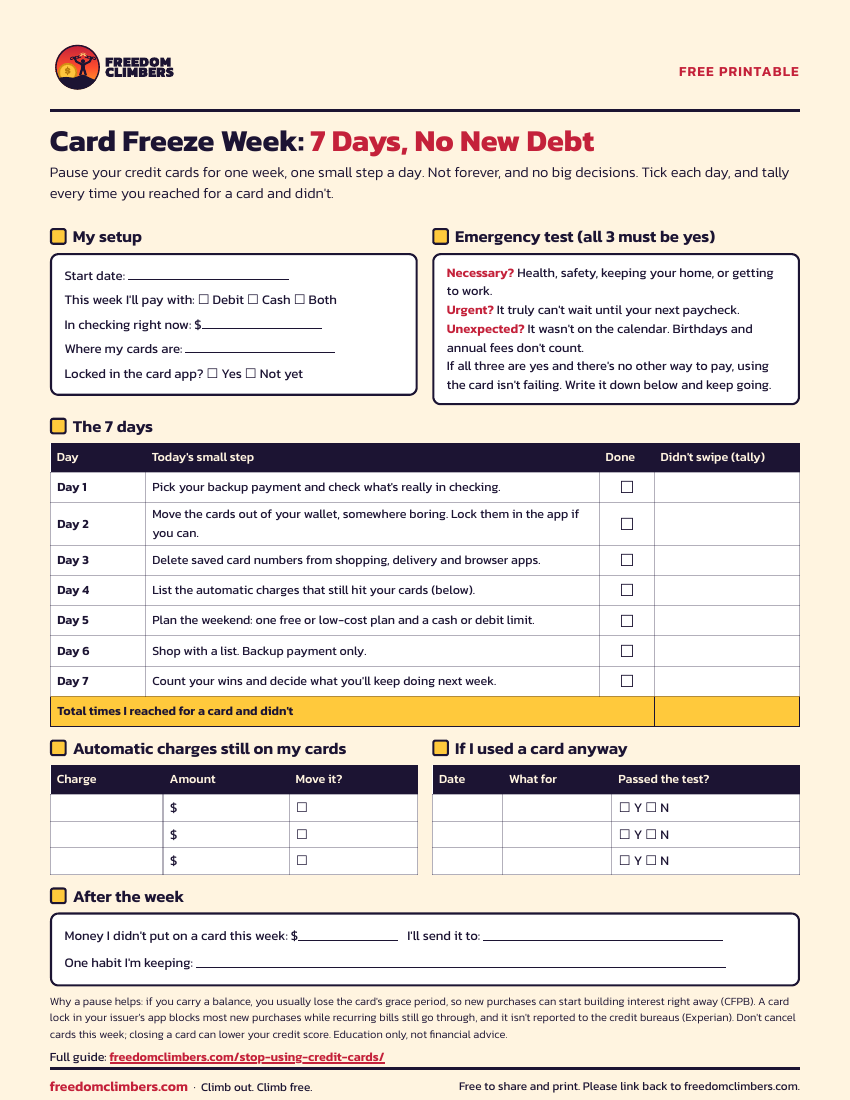
Free printable: Card Freeze Week tracker
Want this challenge on paper? The one-page PDF has all seven daily steps with a tick box, a tally for every time you reached for a card and didn’t, the three-question emergency test, and space to list the automatic charges still on your cards. Stick it on the fridge. No email signup. More one-page tools, including a debt list and bill calendar, are on our free printables page.
How to stop using credit cards: questions people ask
Should I cancel my credit cards?
Not this week. The point is a pause, not a big decision. When you do decide, know the tradeoff. The CFPB says closing a card can lower your credit score, because part of your score looks at how much of your available credit you’re using. Closing can still make sense if the card has an annual fee or bad terms, if it helps you stop adding debt you can’t pay off, or if you aren’t planning to apply for credit soon.
If you keep a card open but stop using it, the CFPB suggests still checking its statements for fees and for charges you didn’t make. And if you close one with a balance, you still pay that balance off on schedule, and interest can keep adding up until it’s paid.
What happens if you stop using a credit card?
Nothing bad right away. But Experian notes that an issuer may lower the limit or close a card that goes unused for months, often with no warning, which can raise your credit utilization. If you pay in full every month, one small recurring bill paid off each month is one way to keep a no-fee card active. If you’re carrying a balance, though, remember the grace period rule above: that small bill may start collecting interest the day it posts. Keeping a card active isn’t a good reason to add interest-bearing charges.
Should I lock my credit card when not in use?
It can help, and it’s a good Tuesday add-on. Many card apps let you lock a card with a tap. Experian explains that a lock blocks most new purchases and cash advances, while recurring payments still go through, and locks aren’t reported to the credit bureaus, so they don’t hurt your credit.
Can I stop using credit cards if my income is short every month?
Yes, but in steps. Run the 14-day check first, cover essentials, and call creditors early if the number stays negative. Cutting the card off before the gap is closed can just trade card debt for missed bills or overdraft fees.
How do I get rid of the balance once I stop using the card?
Stopping new charges is step one. Then aim every extra dollar at what’s already there:
- Make the call. Ask for a lower APR with our lower interest rate script. If you can’t pay the minimum, the CFPB says to contact your card company right away and explain what you can pay.
- Pay more than the minimum. Our minimum payment calculator shows how much faster a fixed payment gets you out.
- Pick an order. With more than one card, compare snowball and avalanche in the debt payoff calculator or the debt snowball spreadsheet.
- Check a balance transfer carefully. A 0% offer can help, but only after the fee and the rate afterward. See are balance transfer cards worth it?
Is it better to pay off a credit card in full or leave a small balance?
Pay it in full if you can. The CFPB says you don’t need to carry a balance on credit cards to get a good score, and paying the balance in full each month helps get you the best scores and keeps interest as low as possible.
If the math doesn’t work
Some weeks, there simply isn’t enough cash for food, rent and gas without a card. That’s not a character flaw; it’s a budget telling you something. Cover essentials first: housing, utilities, food, transportation to work.
If you have unused items you can part with, our guide to selling stuff for cash safely covers pricing, meetups and payment scams.
Then call before you fall behind. You can talk to your credit card company yourself and ask what payment options it offers, before a payment is late. Our hardship call script gives you the words, and our hard call scripts cover late fees, due dates and collectors.
Your climb this week
Seven days of no new charges unless your emergency test says yes, plus one honest 14-day check. Every time you leave the card in the drawer, you’re stepping off the down escalator and onto the trail.
Checking in midweek? Tell us how it’s going in the Freedom Climbers forum. All our calculators and planners are on the free tools page.
Your next step: Once the swiping slows, see every balance in one place. Put Every Debt on One Page: The List That Starts Your Climb
Next on the climb: Card on pause? Next, lower what the balance left on it costs you: how to ask for a lower interest rate.
Also on the climb: how to check your credit report for free.
Featured photo: Mizuno K on Pexels (New York City, United States).



Leave a Reply