

Every year it sneaks up the same way. One week it’s still warm out, and the next you’re standing in a store aisle doing math in your head, wondering which card has room left. This year can go differently, and it starts with a Christmas sinking fund you open today, while there are still enough paydays left to make it small.
Here you’ll count your paydays, set one honest number and split it into pieces you can actually handle.
What is a Christmas sinking fund?
A Christmas sinking fund is money you set aside a little at a time for holiday costs you already know are coming. It isn’t an emergency fund. The holidays aren’t a surprise; only the cash is. If you’re new to the idea, our guide to sinking funds for beginners explains the basics.
Starting in October matters because time does the heavy lifting. The Consumer Financial Protection Bureau suggests starting your holiday plan as early as possible, so you can look at how much you’ll earn between now and the holidays and work out how much you can save. The same total split over more paychecks means a smaller bite from each one.
Your holiday fund in four steps
1. Count your paydays left. Grab a calendar and count every payday between today and the week you usually shop. Write that number down. If your pay changes, use a careful guess.
2. Set one total, not a wish. The CFPB suggests first making sure your usual bills, like rent, are covered, then estimating the other holiday costs, such as hosting or travel, before deciding what’s left for gifts. Gifts are only part of it. Add the extras that hide in December:
- Gifts for each person
- Wrapping, cards and shipping
- Holiday food and treats
- Travel or gas to see family
- Decorations, a party or a school exchange
3. Divide. Your total divided by your paydays left is your per-paycheck number. That’s the whole formula.
4. Make it automatic. Set a small transfer to a separate savings account on each payday so you don’t have to remember. Our post on how to automate savings walks through the setup.

The gift list template (copy this today)
The CFPB recommends making a gift list and setting a personal rule, such as “If it isn’t on my list, I don’t buy it,” and tracking what you spend as you go. Here’s a simple version:
Name: ____ · Gift idea: ____ · Limit: $____ · Spent: $____ · Done? ☐
Extras: wrapping $____ · food $____ · travel $____
Holiday total: $____ ÷ paydays left: ____ = $____ per paycheck
My rule: If it’s not on this list, it waits until January.
Keep it on your phone or on the fridge. When a “deal” pops up, check the list before you check out.
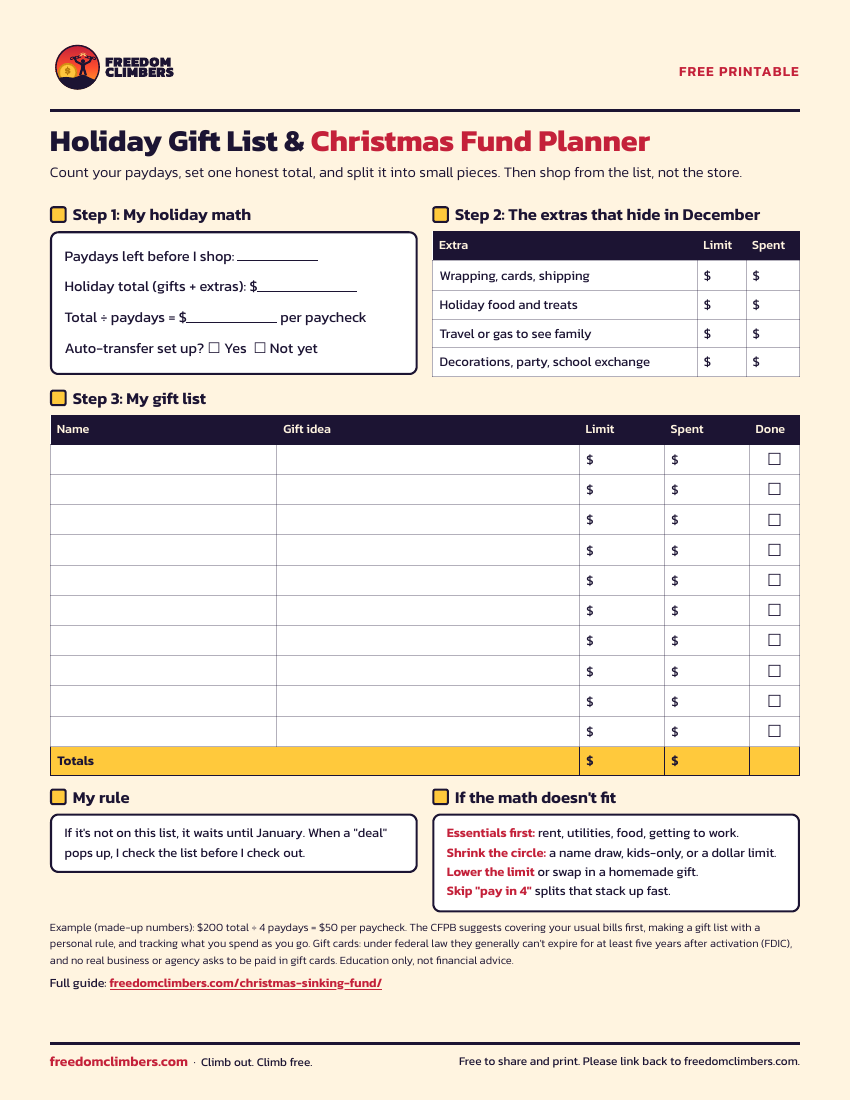
Free printable: Holiday Gift List & Christmas Fund Planner
Prefer paper? This one-page PDF has the paydays math, a 10-person gift list with a limit and spent column for each, the December extras, and your “not on the list, it waits” rule. Stick it on the fridge. No email signup. More one-page tools are on our free printables page.
A worked example
Here’s an example with made-up, round numbers. Say you’re paid every two weeks and you count four paydays left before your shopping week.
- Gifts for six people at $25 each: $150
- Wrapping, cards and shipping: $20
- Holiday dinner extras: $30
That’s a $200 holiday total. Divide $200 by four paydays and you get $50 per paycheck.
If $50 doesn’t fit, you could trim the list rather than reach for a card. Drop the per-person limit to $20 and the gifts cost $120, which brings the total to $170, or about $43 a paycheck. Or swap two store-bought gifts for homemade ones. The CFPB shares low-cost ideas like homemade hot chocolate or cookie mixes in a jar. Waiting until December would cut the paychecks left, and the same $200 could need $100 or more from each one.
A quick word on gift cards
Gift cards can be a handy way to stick to a set amount per person. The FDIC explains that under federal law, a gift card generally can’t expire until at least five years after it was activated, and inactivity fees are limited. It also suggests buying from sources you know, checking that the codes on the back haven’t been scratched off, and reading the fine print for fees. And remember: no real business or government agency asks you to pay them with gift cards. That’s a scam.
If the math doesn’t work
Maybe even a trimmed number won’t fit this year. That’s okay. Small steps count.
- Essentials first. Rent, utilities, food and getting to work come before any gift. The CFPB’s plan starts the same way.
- Shrink the circle. Suggest a family name draw, a kids-only list or a dollar limit for everyone.
- Skip the “pay later” trap. Splitting gifts into four payments can stack up fast; our guide on buy now, pay later late fees explains why.
- Line up December’s bills. Our post on lining up your bills with your paydays can show which weeks have room.
- Call early. If a bill is going to come up short, our hardship call script gives you the words.
Your Safety-Net Thursday climb
Count your paydays, write one total and move the first few dollars on your next payday. A small fund started now can make December feel lighter.
Next climb: Your holiday fund covers what you can see coming; an emergency fund covers what you can’t. Build a Starter Emergency Fund Without Waiting for a Raise
Next on the climb: How to Say No to Spending Without Losing Friends (Kind Scripts Inside). How to say no to spending without losing friends: kind scripts for invites and group gifts, free swaps to suggest, and a simple plan for the yeses.
Featured photo: Helena Lopes on Pexels (none listed).



Leave a Reply